Tarot Readings and Interpretation
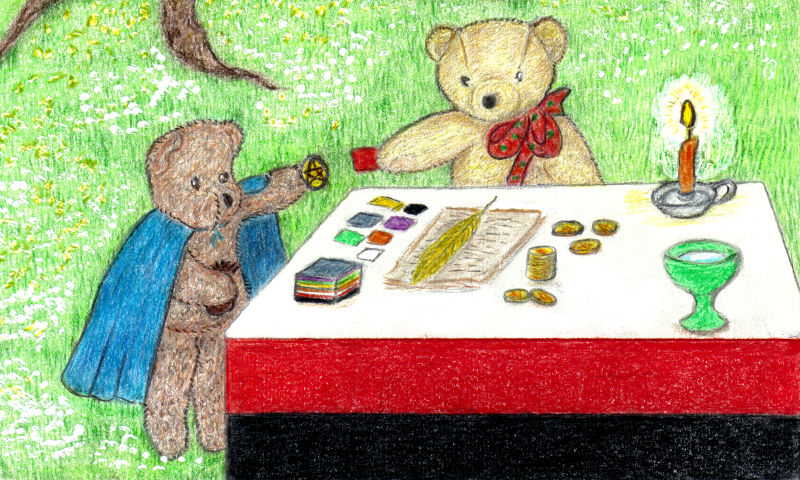
There are many ways to use the Tarot cards. You may wish to study in detail the inner symbolism of the cards, to delve into the worlds of the spiritual and physical and learn how they interact with our daily lives. Or you may simply like looking at the pictures.
One popular use is by laying out the cards and taking from them a meaningful reading, known as Divination. Divination is a slightly misleading term: the cards cannot foretell the future, nor can they advise you on a particular course of action. What they can do is to open your mind to the influences and possibilities that surround you, and to enable you to make informed choices. But you must remember that any action you take is always your choice alone: you always have free will.
Divination uses many different arrangements of cards, known as spreads. These pages present a few of the simplest and most popular. If you are new to Tarot, you should start with the least complicated layouts, and progress to others as you become more confident in your interpretation of the cards.
Some notes on the spreads:
You can do a reading for yourself, or for someone else. The querent is the person for whom the reading is being done. In all cases, you must be sure that your mind is focused on the circumstances and needs of the querent, and not of yourself. In some spreads, doing so may be assisted by designating one card as the significator, which may represent the querent, or the influences and circumstances that currently surround them.
A reading may be performed with the object of answering a specific question. This must be done with the caveats already given regarding what the Tarot can and cannot do, but in addition being sure that focusing on a specific aspect is not closing either the reader or the querent off from the idea of other options or influences. In many instances, a general, non-specific, reading may be more appropriate.
The Tarot pack should always be thoroughly shuffled, and as a final step before laying them out, the pack should be cut by the querent (into 2 or 3 stacks, according to preference) then reassembled in a different order.
Some Tarot users apply great significance to a card that lies upside down. Ideally, the cards should always face the querent (which means that they are upside down for the reader, if they are sitting on the opposite side of a table). If one card is inadvertently upside down, some readers interpret this as having the meaning of the card completely reversed. Others simply ignore the change. This writer would suggest that it is drawing attention to the importance of a particular card in the reading, but does not radically affect its meaning.
There are many online and printed resources for anyone who wishes to take the subject of Tarot Divination to a more advanced level.
If you would like to own a full deck of Ted’s Tarot cards, you can buy it here.