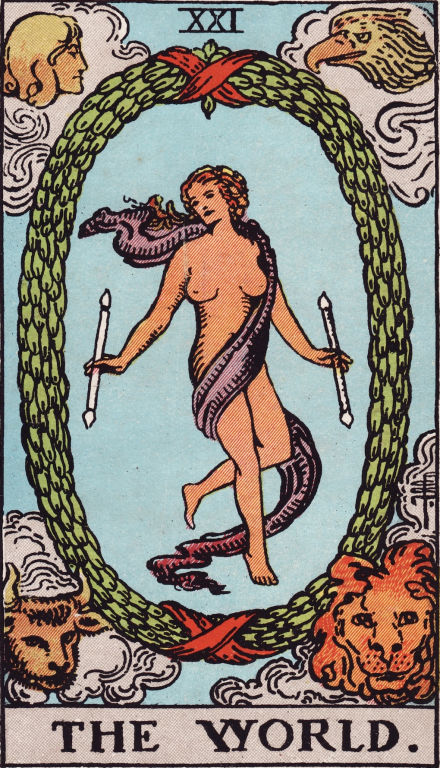
The World card from the Arthur Edward Waite deck
illustrated by Pamela Coleman Smith.
It bears a close resemblance to the card included in
the 16th century Marseille tarot pack.
What is Tarot?
The earliest known tarot decks date from the 15th century, although they probably originated even earlier than that. Initially, they were used to play a complex card game, probably the ancestor of the little known modern game of Tarocchi. No doubt they were also used for divination, similar to the way that modern playing cards are sometimes used today.
There have been a number of variations in the arrangement of the tarot deck, but the 78 card deck became the most common, and is the style used by most modern decks, including Ted’s Tarot.
The 78 card deck contains 22 cards, historically known as Trionfi or Trumps, but now usually referred to as the Major Arcana. The remaining 56 cards are arranged in four suits of 14 cards each, collectively known as the Minor Arcana. The familiar deck of modern playing cards is a direct descendant of the suit cards of the tarot: the suits have been renamed, and one of the 4 court cards had been removed from each suit, but the resemblance is clear. Sometimes one of the Major Arcana is included in the modern deck, in the form of the Joker, or Fool.
In the 19th century, an upsurge of interest in all manner of mystical and spiritual matters led to renewed interest in tarot. A number of new tarot decks appeared, perhaps the most influential of which was the one designed by Arthur Edward Waite and illustrated by Pamela Coleman Smith, published in 1909. It emphasised the symbolic and mystical meaning of the cards, and was notable in having a fully illustrated minor arcana; many other decks had minor arcana marked simply by the relevant number of small symbols, as with the pip cards of modern playing card decks. This deck was very popular and widely used; it is still readily available today in reprint form. Echoes of the elements introduced in it can be found in almost all later tarot decks, Ted’s Tarot included, and there is no doubt that its execution is based on a deep understanding and insight of the tarot. However, it must be said that it is very much of its time, and there are aspects that do not resonate well with the sensibilities of today. Over the last century and more, many new tarot decks have appeared. The better ones have tried to address some of these issues with the Waite/Smith deck, with varying degrees of success. Ted’s Tarot aims to be one of these, bringing out the symbolic imagery in the clearest way possible, and trying to relate equally to people of any age, gender, or cultural background. After all, who in their heart is not able to relate to a teddy bear? You may be the judge of whether we have succeeded in our aims.
If you would like to own a full deck of Ted’s Tarot cards, you can buy it here.